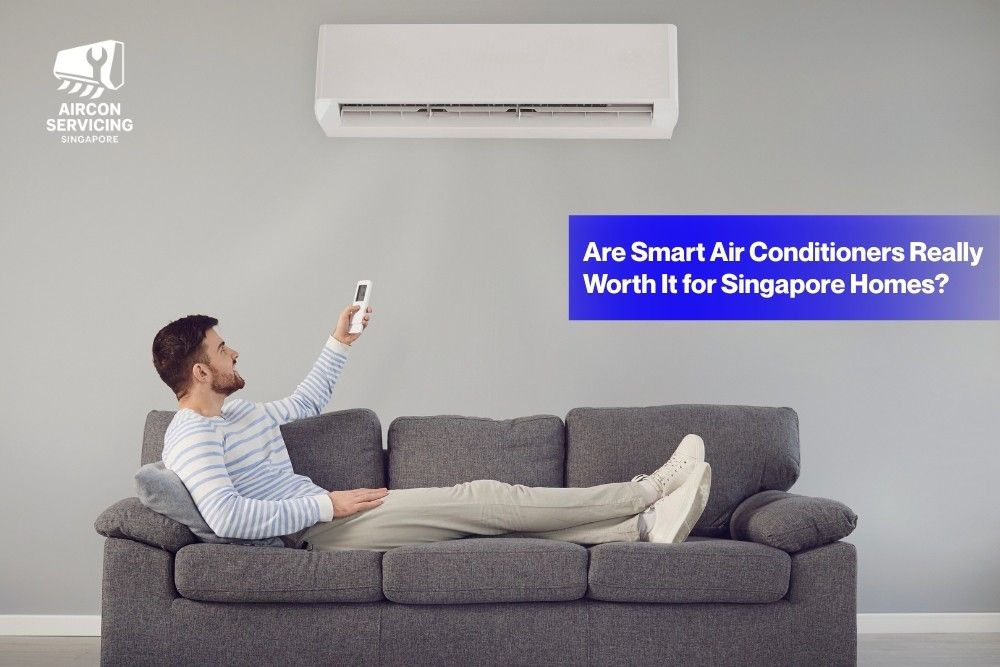
Yes, smart air conditioners are worth it for most Singapore households, especially if your monthly electricity bill makes you sweat as much as the midday sun.
Air conditioning accounts for roughly 40% to 50% of a typical Singapore household’s monthly electricity bill. Smart air conditioners deliver practical value in Singapore’s tropical environment through three key capabilities:
- Remote Scheduling & Geo-fencing: You can pre-cool your HDB flat or condo 10 minutes before reaching home, avoiding the impulse to crank the temperature down to an inefficient 18°C.
- Dynamic Temperature Sleep Curves: Singapore nights are humid. Instead of freezing at 3 AM and waking up with a sore throat, smart units gently increase the room temperature by 1°C to 2°C after you fall asleep, trimming power usage by roughly 5% to 10% each night.
- Filter & Maintenance Alerts: Humidity breeds mold. Smart units track runtime hours and flag when airflow is choked before sludge causes the dreaded water-drip emergency.
- The Retrofit Alternative: If your existing 5-tick inverter system is still in great shape, you do not need to replace the entire system. Adding an external smart infrared controller (such as Sensibo or Ambi Climate) for under $150 gives you the exact same smart automation features without replacing your fan coils.
Smart Aircon vs Standard Aircon: What Are You Really Paying For?
A smart air conditioner doesn’t necessarily cool a room better just because it connects to Wi-Fi. The real upgrade is control. A conventional inverter aircon and a smart inverter aircon may use similar cooling technology, but the smart model gives homeowners more ways to manage when, where, and how that cooling happens.
Here is where the difference becomes practical:
| Feature | Standard Aircon | Smart Aircon |
| Remote Control | Physical remote | Smartphone app plus physical remote |
| Scheduling | Basic timer on selected models | Detailed daily or weekly schedules |
| Control Away From Home | Usually unavailable | Switch the unit on or off remotely |
| Geo-fencing | Usually unavailable | Available on compatible systems |
| Energy Monitoring | Limited or unavailable | Usage insights on supported models |
| Maintenance Reminders | Manual tracking | Automated filter or runtime alerts |
| Smart Home Integration | Limited | May work with compatible voice assistants and home automation platforms |
However, smart functionality also introduces a few trade-offs. Native smart models may cost more than comparable conventional units, some features depend on a stable Wi-Fi connection, and app functionality varies between manufacturers. A homeowner who simply switches the aircon on before sleeping and off in the morning may see little value in paying extra for advanced automation.
The strongest value appears in homes where cooling patterns change throughout the day. Families with several bedrooms, people who regularly forget to switch units off, shift workers, and homeowners who want greater control over operating hours are more likely to benefit.
If your current inverter system is already efficient and reliable, a compatible smart controller may offer many of these conveniences without requiring a complete replacement.
Smart Features Cannot Replace an Efficient Aircon
One important catch when deciding whether a smart air conditioner is worth the money: software cannot compensate for poor physical performance.
An app can tell your aircon when to start cooling, but it cannot force air efficiently through a filter packed with dust. Geo-fencing may stop unnecessary runtime, but it cannot clear a blocked drainage pipe. Energy-monitoring features can reveal unusual consumption, but dirty evaporator coils, failing components, restricted airflow, or other mechanical problems still require inspection and maintenance.
That is why smart controls and proper servicing work best together.
The Complete Guide to Better Aircon Servicing in Singapore
Imagine running a marathon every single day while breathing through a dusty blanket. That is what your air conditioner goes through in Singapore!
Our island is hot and sticky all year round. Because we use our cooling units so much, regular Aircon Servicing isn’t just a nice-to-have chore—it is essential to prevent water leaks, kill smelly black mold, and keep your power bills low.
What Really Happens During an Aircon Servicing?
When you book professional aircon servicing, a trained technician does not just wipe down the plastic cover. Real maintenance involves cleaning the inside parts so cold air flows freely:
- Air filter extraction and cleaning: Removes trapped pet dander, dust mites, and dirt.
- Evaporator coil rinse and dust brush: Cleans the metal fins where heat exchange takes place.
- Clearing the condensation drainage pipe: Technicians use a high-powered wet vacuum to flush out built-up “jelly” (algae and bacteria) that causes indoor water dripping.
- Blower fan wheel scrub: Cleans off the sticky dust layers that slow down wind speed and create squeaking noises.
- Electrical safety and refrigerant pressure checks: Ensures wiring connections are tight and refrigerant gas levels are normal.
Comparison of Servicing Types: Which One Do You Need?
Not all maintenance visits are identical. Choosing between standard maintenance, a chemical flush, or a complete teardown depends entirely on the condition of your unit:
| Service Type | What Technicians Do | Best For | Typical Singapore Price |
|---|---|---|---|
| General Servicing | Cleans filters, wipes casing, brushes coils, and vacuums drain pipe. | Routine quarterly upkeep for smooth, working units. | $25 – $45 per unit (cheaper in multi-unit bundles) |
| Chemical Wash | Uses a specialized alkaline foaming cleanser directly on the mounted cooling coil fins. | Units blowing weak air, smelling sour, or with greasy buildup. | $75 – $100 per unit |
| Chemical Overhaul | Completely disassembles the fan coil off the wall to soak internal parts, water tray, and fan wheel in chemical baths. | Severely clogged coils, chronic water leaking, or heavy mold infestations. | $130 – $180 per unit |
How Much Is Aircon Servicing in Singapore?
When checking an aircon servicing price Singapore menu, costs drop when you bundle multiple units together:
- Single Unit Ad-hoc Visit: $40 to $50.
- System 3 or System 4 HDB Bundle: $70 to $100 per trip total.
- Annual Contract (4 visits per year): $200 to $340 per year depending on how many indoor units you own.
- Gas Top-up (R32 or R410A Refrigerant): $60 to $150 (only required if there is an active leak; sealed systems do not naturally consume refrigerant gas).
How Often Aircon Servicing Is Needed
- Bedrooms (used 8 hours every night): Every 3 months.
- Home Office or Living Rooms (used occasionally): Every 4 to 6 months.
- Commercial Spaces and Offices (used 10+ hours daily): Every 1 to 2 months under a dedicated commercial aircon servicing maintenance plan.
4 Warning Signs Your Unit Needs Immediate Servicing
- Water Leaking Down the Wall: Algae and mold have accumulated inside the drain pan, forcing condensed water to spill over your wall or floor.
- The Air Feels Warm or Musty: Thick dust on the indoor evaporator fins stops the system from absorbing heat from the room.
- Chattering, Whistling, or Vibrating Sounds: The indoor blower fan has an uneven coating of dirt, throwing the rotation off balance.
- Icing on the Copper Pipes: Blocked air filters choke off airflow, causing the refrigerant temperature to drop until moisture on the metal coils turns into solid ice.
The Verdict: Are Smart Air Conditioners Worth It?
Homeowners trying to reduce cooling costs can also explore our guide to aircon energy-saving tips for Singapore homes, which explains practical ways to improve efficiency through temperature settings, airflow, smart controls, and regular maintenance.
At Aircon Servicing Singapore, we recommend looking at the entire cooling system rather than relying on smart features alone. A well-maintained conventional inverter can sometimes be a better investment than a feature-packed smart unit that is poorly maintained. Likewise, a smart aircon delivers its best value when the filters, coils, drainage system, blower, and other components are kept in good working condition.
So, are smart air conditioners worth it for Singapore homes? For households that will actively use scheduling, remote control, automation, and monitoring, the answer can certainly be yes. For homeowners who mainly want reliable cooling at the lowest possible cost, maintaining an efficient existing inverter system and adding selected smart controls may be the more practical choice.
Whichever option you choose, keeping the system clean and mechanically healthy remains essential. That brings us to an equally important part of owning any air conditioner in Singapore: regular aircon servicing.
Frequently Asked Questions
Why does my aircon leak water even right after a simple service?
Loose debris from a quick cleaning can wash into the drainpipe and mix with standing moisture, forming a gelatinous plug that causes backflow. A qualified technician will vacuum the drainpipe from both ends to ensure clear drainage.
Do I need a gas top-up during every service trip?
No. Air conditioners operate as closed-loop circuits; they do not burn refrigerant like petrol. If a workshop claims you need gas top-ups every few months, your unit likely has a physical leak in the copper joint or flare nut that requires brazing and repair, not simply a quick refill.
Is it better to sign an aircon servicing contract or pay per visit?
Annual servicing contracts are almost always more economical. Besides lowering the cost per visit by 20% to 30%, reputable maintenance agreements in Singapore typically include extended 90-day workmanship warranties against drainage leaks and offer priority slots during hot months.