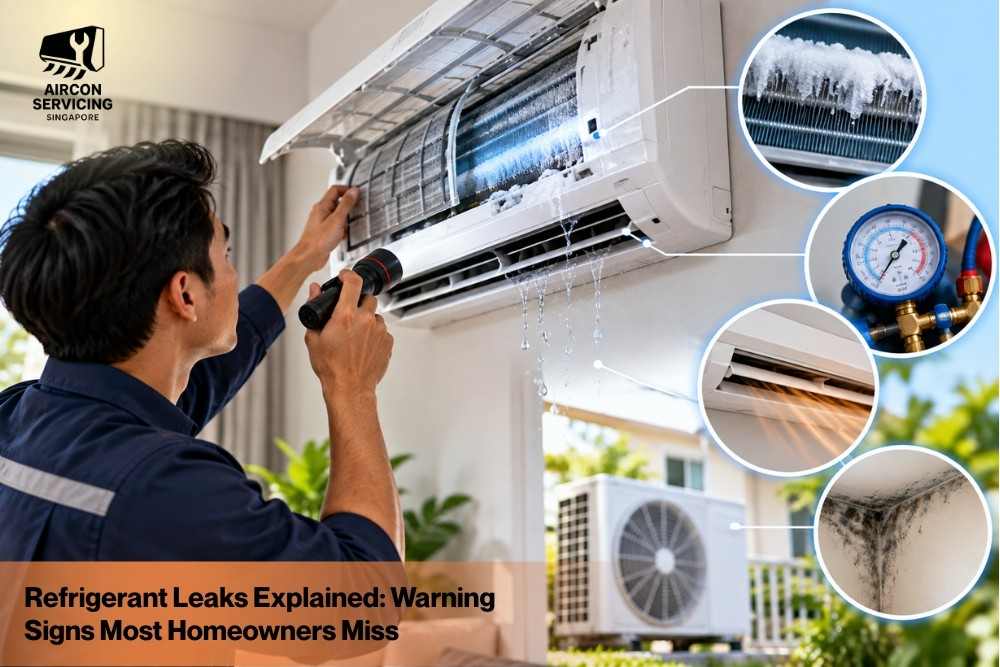
An aircon refrigerant leak shows through weak airflow, lukewarm air, bubbling sounds, indoor coil icing, and unexplained spikes in utility bills. Because closed cooling loops don’t naturally consume refrigerant, pressure loss signals copper corrosion or cracked flare joints. Timely detection prevents catastrophic motor burnouts and restores energy performance across residential air conditioning setups.
You walk into your apartment after a sweltering afternoon, eager for crisp comfort. You switch on your wall blower, yet the room stays warm and humid. The vents blow room-temperature air while the outdoor compressor hums continuously on your ledge. Booking timely Aircon Servicing in Singapore stops minor internal leaks from escalating into total hardware failure.
Many families mistake failing cooling efficiency for simple dust accumulation. They wash their plastic filters and wait patiently, yet relief never arrives. Cooling networks need steady gas density to complete heat-transfer cycles under intense tropical humidity. A hidden chemical escape forces internal components to operate under severe thermal stress.
Industry metrics from early 2026 indicate that refrigerant pressure loss causes over 42 percent of residential compressor failures across local housing estates. When gas escapes through pinhole fractures, motors run longer to compensate. Ignoring these early warning signs can turn an economical patch into an expensive system replacement. Prompt technical intervention protects your machinery and reduces unnecessary power consumption.
The Operational Reality: Quick Gas Top-Ups Versus Modern Diagnostic Repairs
Many contractors offer rapid chemical gas top-ups without testing joint integrity. Modern technical standards prioritize definitive electronic isolation to permanently stop persistent refrigerant loss.
| Operational Dimension | The Quick Top-Up Habit | Comprehensive Diagnostic Repair | Direct Impact On Homeowners |
|---|---|---|---|
| Primary Remediation | Pumping chemical gas into leaking coils | Nitrogen pressure isolation and brazing | Resolves root corrosion and terminates gas loss |
| System Durability | Temporary cooling lasting a few weeks | Multi-year pressure retention | Protects the sealed compressor from motor seizure |
| Household Utility Costs | High electrical bills from strained motors | Calibrated baseline energy usage | Saves hundreds of dollars on monthly power bills |
| Diagnostic Method | Visual checks with soapy water | Digital ultrasound and halogen detection | Locates micro-fissures hidden deep inside chassis |
| Safety Assurance | Lingering chemical emissions indoors | Hermetic loop seal certification | Ensures safe, pure ambient indoor air circulation |
Why Tropical Humidity Triggers Silent Refrigerant Loss
Air conditioners run almost continuously in our hot, humid climate. Outdoor condenser units face high moisture, saline sea breezes, and heavy airborne cooking particles. These elements generate microscopic acidic films that trigger formicary corrosion on delicate copper tubes. Understanding aircon refrigerants helps explain why closed cooling loops must remain completely enclosed throughout their service life.
Copper tube walls thin out over several years of rigorous operation. Microscopic stress fractures emerge along curved joint bends and brass flare unions. Because modern cooling gases lack sharp odors, silent escapes persist for weeks without obvious warnings. An under-pressurized system starves the mechanical pump of lubrication oil, causing internal motor friction.
Specialized diagnostics prevent premature equipment retirement. Experienced technicians use sensitive electronic halogen sensors to track escaping molecules. Resolving joint fatigue early keeps your living spaces comfortable and stops recurring repair fees.
Subtle Symptoms Homeowners Frequently Overlook
Refrigerant drops show up in unusual mechanical patterns before complete failure. Homeowners should monitor these distinct indicators:
- Faint Hissing or Bubbling: Escaping gas can produce a continuous whistling sound behind indoor plastic casings.
- Frozen Evaporator Ribs: Low internal line pressure drops evaporation temperatures, covering metal coils in visible frost.
- Oily Copper Residues: Lubricating oil circulates with refrigerant, leaving dark greasy films around leaking connection points.
- Climbing Electric Bills: Strained compressors work twice as hard to satisfy thermostat thresholds, increasing power draw.
- Soggy Indoor Air: Undercharged cooling loops fail to extract airborne moisture, leaving rooms humid and sticky.
Observing these subtle clues protects your household budget. Addressing mechanical drops promptly preserves cooling efficiency and restores clean ventilation.
Step-by-Step System: Professional Detection And Restoration
Restoring a depressurized aircon demands disciplined engineering practices. Certified technicians execute this ordered diagnostic sequence:
Conduct An Electronic Halogen Sniffer Audit
Technicians trace the entire copper circuit using sensitive digital sensor probes. The sensor detects tiny halogen concentrations escaping through inaccessible casing seams.
Practitioner Insight: In our local field diagnostics, we consistently find that flare nuts on multi-split distributor boxes crack from historical over-tightening during initial estate renovations.
Execute High-Pressure Nitrogen Gas Isolation
Specialists evacuate leftover chemicals and pump dry nitrogen into isolated copper circuits. Digital gauges monitor pressure drops over 24 hours to pinpoint specific pipe breaks.
Practitioner Insight: Pressurizing isolated lines to 350 PSI reveals tiny hairline cracks that standard soap bubble tests routinely miss.
Perform Precision Copper Brazing And Flare Replacement
Technicians cut damaged copper lengths and braze fresh industrial-grade sections using silver-alloy rods. Precision flare tools reshape brass connection collars to create perfect mechanical seals.
Practitioner Insight: Applying specialized anaerobic sealing compounds to clean flare faces prevents recurring micro-leaks caused by normal wall-vibration harmonics.
Deep Vacuum Dehydration And Moisture Evacuation
A heavy-duty rotary vacuum pump purges ambient air and trapped condensation from the circuit. The system must maintain a deep vacuum below 500 microns before technicians add fresh gas.
Practitioner Insight: Skipping proper micron vacuum purging leaves moisture inside the lines, creating hydrochloric sludge that destroys compressor motor windings within months.
Gravimetric Refrigerant Charging By Exact Factory Weight
Engineers weigh fresh refrigerant into the circuit using calibrated digital platform scales. Charging strictly matches original manufacturer specifications rather than relying on pressure gauges alone.
Practitioner Insight: Charging gas by exact gram weight on digital scales produces consistent subcooling temperatures, preventing high electrical consumption.
Systematic repairs eliminate repetitive servicing calls. Discovering why your aircon isn’t cooling properly helps homeowners choose permanent engineering solutions over short-lived adjustments.
Real-World Scenarios: How Early Detection Prevents Major Expenses
The Frosting Master Bedroom Fan Coil
A family in a Punggol condominium noticed their master bedroom unit dripping water onto the floorboards. The internal fan blew lukewarm drafts despite the thermostat showing nineteen degrees. The homeowner assumed the drainage pipe got choked and placed towels underneath the unit.
During the inspection, our technical team found thick sheets of ice covering the evaporator coil fins, and an electronic sensor detected a hairline crack along the expansion valve connection pipe. The technician vacuumed the lines, re-brazed the joint with silver solder, and recharged the unit by weight. The unit returned to quiet operation, preventing water damage to the surrounding timber flooring.
The Strained Multi-Split Living Room Compressor
A resident in an Ang Mo Kio apartment received an electricity bill that had doubled over two consecutive billing cycles. The living room blower ran continuously throughout the evening without lowering the room temperature. The owner thought the outdoor weather had grown hotter.
Our diagnostic audit revealed the system was operating at merely thirty percent of its specified factory gas pressure. The compressor motor ran continuously at high temperatures, driving up electricity usage. Our team rebuilt the faulty flared joints on the outdoor condenser service valves. Restoring proper gas pressure brought the household utility bill back to baseline levels the following month.
Critical Mistakes That Accelerate System Breakdown
Avoiding common maintenance oversights protects your air conditioning machinery from avoidable breakdowns:
- Accepting Routine Chemical Gas Top-Ups: Adding refrigerant without finding and sealing structural leaks wastes money on gas that keeps escaping.
- Operating Frosted Blower Units: Running an iced system strains internal components and risks liquid refrigerant slugging directly into the compressor.
- Hiring Unqualified Freelance Handymen: Untrained technicians lack precision vacuum pumps and digital scales, leading to inaccurate gas charges.
- Ignoring Unusual Mechanical Vibrations: Loose mounting brackets shake copper pipes, causing metal fatigue and eventual joint fractures.
- Delaying Scheduled Quarterly Maintenance: Skipping preventive inspections prevents technicians from catching minor oil leaks before compressors fail.
Disciplined operational habits preserve mechanical integrity. Routine care prevents sudden hardware failures and ensures dependable year-round cooling performance.
Frequently Asked Questions
Does An Air Conditioner Naturally Consume Refrigerant Over Time?
An air conditioner never consumes or burns through refrigerant during normal operation. Cooling systems function as hermetically sealed closed circuits, recycling the same chemical gas indefinitely. If your cooling system loses pressure, it indicates a physical leak within the copper pipes, valves, or coils. Adding fresh gas without repairing the physical breach wastes money, as the newly added refrigerant escapes rapidly.
How Much Does A Professional Leak Repair Cost In Singapore?
Repair costs depend on the leak’s location and the repair’s complexity. Minor flare joint replacements at accessible service valves are relatively economical. In contrast, repairing pinhole corrosion buried deep inside internal evaporator coils requires extensive labor and brazing. Reputable service providers provide clear upfront quotes after comprehensive nitrogen pressure testing, ensuring no surprise fees.
Can Running An Aircon With Low Gas Destroy The Compressor?
Operating an undercharged system damages the central compressor motor. Cool returning refrigerant gas lowers motor operating temperatures, while circulating oil lubricates internal bearings. When gas levels drop, the motor overheats and runs without adequate lubrication. This continuous thermal stress degrades internal insulation, eventually causing catastrophic mechanical seizure.
How Do Technicians Distinguish Between A Dirty Coil And A Gas Leak?
A dirty coil restricts air movement, causing weak airflow while keeping the air blowing through relatively cool. In contrast, a refrigerant leak allows strong airflow, but the air coming out remains lukewarm. Technicians use digital manifold gauges and infrared thermometers to measure operational pressure and temperature differences. These diagnostic measurements confirm whether your cooling issues stem from surface dust or gas loss.
Is Refrigerant Gas Harmful If It Leaks Inside A Bedroom?
Modern residential refrigerants are non-toxic in small quantities, but an active leak requires immediate attention. Escaping gas displaces breathable oxygen within enclosed, unventilated rooms. Leaking refrigerant also carries atomized compressor oil, which can irritate sensitive airways and leave residue on furniture. Shutting down a leaking unit protects your indoor air quality and prevents hardware damage.
Safeguard Your Home Comfort Today
A properly working air conditioner is essential for daily living in our tropical climate. Ignoring minor cooling drops, odd bubbling sounds, or slight spikes in power bills leads to avoidable system breakdowns. Properly maintaining internal refrigerant circuits protects your family from uncomfortable, humid living spaces and costly emergency repairs.
Partnering with dependable cooling specialists ensures your equipment gets the exact care it needs. Experienced technicians find tiny micro-leaks, rebuild worn copper connections, and recharge systems using strict factory weights. Protect your home comfort and extend equipment life by choosing comprehensive Aircon Servicing in Singapore to keep your system running reliably year after year.