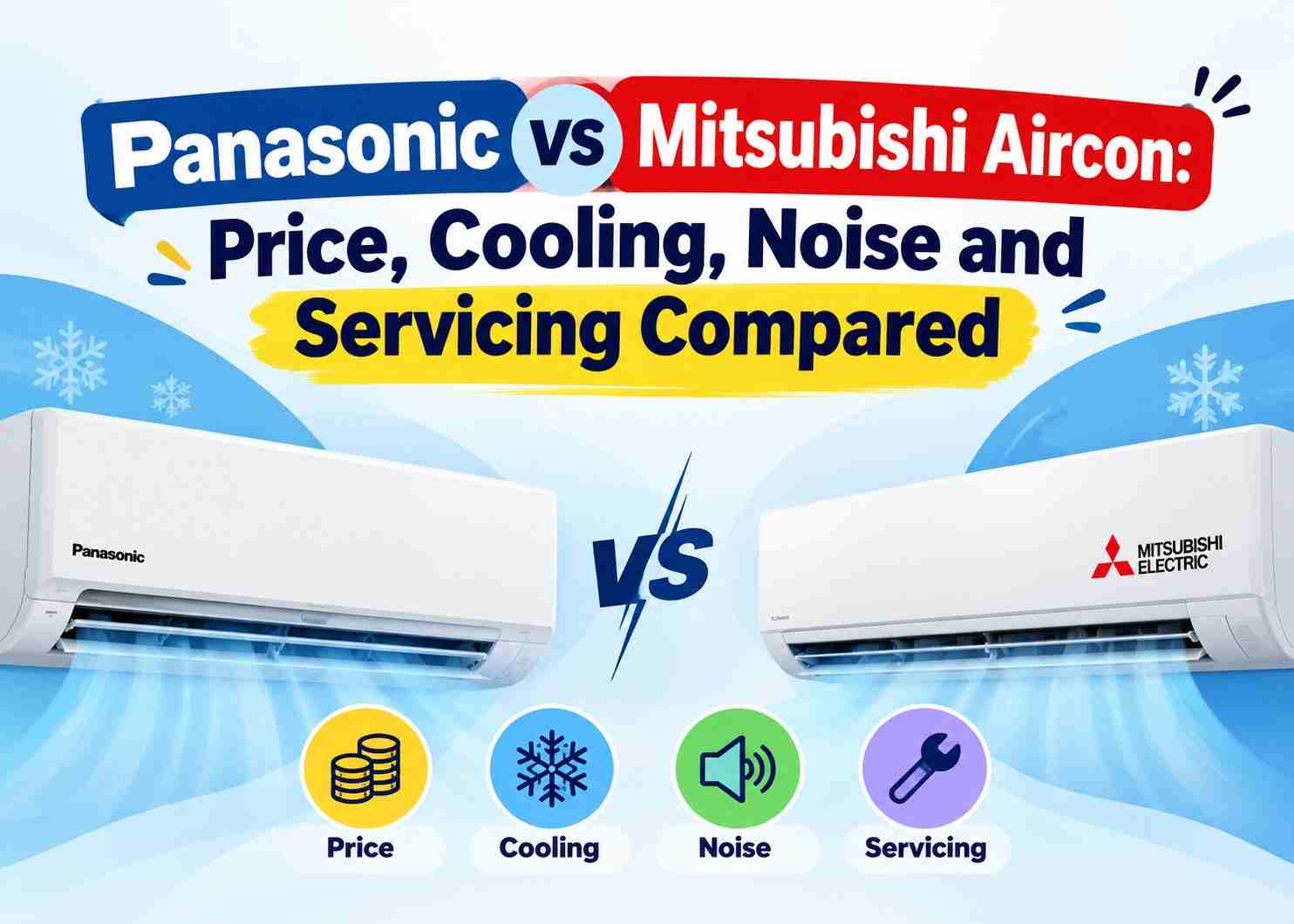
Both Panasonic and Mitsubishi are well-regarded aircon brands in Singapore, and both give a 5-year compressor warranty. Choose by model, not brand: compare the specific model’s energy rating, noise level, price and your installer’s experience. Mitsubishi Electric’s own terms make routine servicing a condition of the warranty, so regular servicing matters for either brand.
Key takeaways
- Compressor warranty is 60 months for both brands in Singapore. Mitsubishi’s general warranty is 12 months from purchase; Panasonic is running a “1+2 year” extended general warranty promotion on selected X-Premium models bought from 1 October to 31 December 2026 and installed and registered by 28 February 2027.
- Mitsubishi Electric’s warranty terms say the warranty is void if routine maintenance servicing is not carried out. Panasonic’s terms exclude cleaning, maintenance and general servicing from warranty cover.
- Neither brand’s warranty covers filters or normal wear and tear.
- Prices and noise vary a lot by series and horsepower. Compare model against model on the same horsepower.
- Both brands need correct installation to perform and keep warranty cover.
Panasonic vs Mitsubishi at a glance
| Panasonic | Mitsubishi Electric | |
|---|---|---|
| Example 1.5HP model compared | CS-XU12XKZW with CU-XU12XKZ | MSY-GP15VF with MUY-GP15VF |
| Cooling capacity | 3.70 kW (1.02 to 4.50 kW) | 4.2 kW (15,000 Btu/h) |
| Energy rating | 5 ticks | 4 ticks |
| Indoor noise | 19 to 43 dB(A), low to high [CONFIRM from datasheet] | 28 to 49 dB(A), low to high |
| Key features | nanoe X and nanoe-G air purification, iAUTO-X, ECO + A.I. mode, Comfort Cloud app control | Inverter, dual barrier coating, PM2.5 microparticle filter, easy-clean design |
| Compressor warranty (Singapore) | 60 months from purchase for units 5HP and below | 60 months from purchase |
| General warranty | 1+2 year extension promo on selected X-Premium models until 31 Dec 2026 | 12 months from purchase |
| Labour on compressor claim | Not covered after the first year | Covered for the first 12 months only |
| Servicing and warranty | Cleaning, maintenance and general servicing are not covered | Warranty void if routine maintenance servicing is not carried out |
| Filters | Not covered | Not covered |
| Brand service charges | Evaluation from S$140, repair service from S$220 per room aircon unit, plus S$45 transport, excluding parts |
Read the model rows with care. The two example models are both sold as 1.5HP but are not the same capacity: the Mitsubishi unit is rated 4.2 kW and the Panasonic unit 3.70 kW. A bigger rating cools faster but is not automatically better for your room. Specs for these models come from the brand’s Singapore catalogue and product listings.
Price: Panasonic vs Mitsubishi
There is no single price gap between the two brands, because both sell many series from entry to premium. [ADD: our typical price range per brand and horsepower, or a note that prices depend on promotions.] To compare fairly:
- Compare the same horsepower and the same number of units (a 1.0HP single split against a 1.0HP single split)
- Compare the same tier: entry inverter against entry inverter, premium against premium
- Compare the installed price, not the unit price: pipework, brackets, drain and electrical works can change the total
- Check for promotions, such as Panasonic’s extended warranty offer on selected X-Premium models
- Compare running cost, using the energy rating and your daily hours of use
Since 1 April 2025, NEA requires single-split units to be at least 4 ticks and multi-split units at least 5 ticks, according to the NEA, so both brands’ new models must meet that floor. A higher tick rating usually costs more to buy but less to run. See our guide to energy-efficient aircon in Singapore.
Cooling performance and features
Both brands make inverter models that adjust output to the room, which saves energy and keeps temperature steady. The real difference comes from the model, not the badge.
What to compare on a datasheet:
- Rated cooling capacity (kW or BTU/h) against your room size
- Energy rating (ticks) and annual energy use
- Air purification and filter features, if you want them [ADD: our view on Panasonic and Mitsubishi air-treatment features from the current models]
- Wi-Fi and app control, if you want to schedule the aircon
- Outdoor unit size, which matters for condo ledges and HDB spaces
A correctly sized unit matters more than a brand. An undersized unit runs flat out and wears faster; an oversized one cycles on and off and cools unevenly. Your installer should size the unit from a site visit. See our aircon installation service, and for multi-room homes read multi-split vs single-split aircon.
Noise: which is quieter?
We do not publish a verdict on which brand is quieter, because noise depends on the model and fan speed. Datasheets list indoor noise in decibels (dB) at different speeds, and both brands make quiet models.
How to compare noise fairly:
- Use the indoor unit’s lowest fan speed figure, since that is what you hear at night
- Compare units of the same horsepower and series tier
- Remember that a difference of a few dB is small, while 10 dB sounds roughly twice as loud
- Check the outdoor unit’s noise too, if it sits close to a bedroom window
- Ask the showroom or installer to run the model so you can hear it
For the two example models in the table, indoor noise is 19 to 43 dB(A) for the Panasonic CS-XU12XKZ and 28 to 49 dB(A) for the Mitsubishi MSY-GP15VF, from low to high fan speed. On these figures the Panasonic is quieter at both ends, but the units differ in capacity, so confirm against the datasheets. [CONFIRM: figures and add outdoor noise.]
A well-serviced unit is quieter. Dirty filters and coils make the fan work harder and can add rattling or whistling. Regular aircon servicing keeps either brand running quietly. For noise problems, see reducing aircon noise.
Servicing, parts and running cost
Both brands are serviced the same way: filters cleaned, coils and drain checked, gas pressure and electrical parts inspected. We service all major brands, including Panasonic and Mitsubishi. Our standard servicing is $50 for 1 unit, $40 per unit for 2 to 3 units and $35 per unit for 4 to 5 units. See aircon servicing price per unit.
Why servicing matters for the warranty. Mitsubishi Electric’s Singapore warranty terms say the warranty is void if routine maintenance servicing is not carried out, and that cleaning and maintenance are not covered. Panasonic’s terms also exclude cleaning, maintenance and general servicing from cover. In both cases the brand will not pay for servicing, so keep your own servicing records. See our guide on how often to service your aircon.
Brand service charges. If you use the brand’s own service centre, Mitsubishi Electric publishes charges starting at S$140 for evaluation and S$220 for a repair service per room aircon unit, plus S$45 transport, excluding spare parts. [ADD: Panasonic’s published service charges if available.]
Parts and repair. Parts availability depends on the model and age. [ADD: our experience with parts availability and repair times for both brands.] For breakdowns, see our aircon repair service.
Running cost. Both brands’ inverter models save energy when serviced regularly. A dirty filter or coil makes any aircon use more power.
Warranty and energy rating compared
Mitsubishi Electric. The limited warranty is 12 months and the compressor warranty is 60 months, both from the date of purchase shown on your proof of purchase. After the first 12 months, the compressor warranty covers the compressor part only, not labour or transport. It excludes refrigerant, filters, normal wear and tear and units used for commercial purposes, and it is void if routine maintenance servicing is not carried out, according to Mitsubishi Electric’s warranty terms.
Panasonic. The compressor warranty is 60 months from purchase for units 5HP and below, and transport, gas and labour for a new compressor are not covered after the first year, according to Panasonic’s terms of warranty. Between 1 October and 31 December 2026, selected X-Premium models also carry a 1+2 year extended general warranty if installed and registered by 28 February 2027, per Panasonic’s promotion page. Check the terms and the eligible model list, because the offer is for end-consumers and needs online registration.
Practical points for either brand
- Keep the receipt: warranty starts from the purchase date
- Use a qualified installer: improper installation and unauthorised repairs can void cover
- Register your unit where the brand asks for it
- Keep servicing records
For energy rating, see the NEA minimum of 4 ticks for single-split and 5 ticks for multi-split units since 1 April 2025 in the price section above.
Panasonic or Mitsubishi: which should you choose?
On the facts we can verify, the brands are close. Use the questions below instead of a brand rule.
| If this matters most | Look at |
|---|---|
| Lowest purchase price | The cheapest model at your horsepower in the entry inverter tier, from either brand |
| Longest warranty cover | Panasonic’s 1+2 year extended general warranty promotion, while it runs and if your model is eligible |
| Quiet bedroom | The lowest-speed indoor dB on each datasheet, at the same horsepower |
| Lowest running cost | The model with the most ticks and lowest annual kWh |
| Easy servicing and repairs | The brand your installer services most often and stocks parts for |
| A multi-room home | Multi-split systems from either brand; compare outdoor unit size and tick rating |
Our view. Pick a model with the right capacity and tick rating, buy it from an authorised dealer, have it installed properly and service it on schedule. That matters more than the badge. [ADD: our recommendation by home type, based on jobs we have done.]
For a wider comparison, read our Daikin vs Mitsubishi vs Panasonic guide.
Frequently asked questions
Is Panasonic or Mitsubishi better?
Neither is better in every case. Compare the specific model’s energy rating, noise, price and warranty, and choose the brand your installer can install and service well.
Which has a longer warranty, Panasonic or Mitsubishi?
Both have a 60-month compressor warranty in Singapore. Mitsubishi Electric’s general warranty is 12 months. Panasonic is offering a 1+2 year extended general warranty on selected X-Premium models bought between 1 October and 31 December 2026.
Is Mitsubishi aircon quieter than Panasonic?
It depends on the model. Compare the indoor unit’s dB at the lowest fan speed on each datasheet, for the same horsepower.
Is Mitsubishi more expensive than Panasonic?
Prices vary by series and horsepower, and both brands have entry to premium models. Compare the installed price for the same capacity and tier.
Does skipping servicing void my aircon warranty?
For Mitsubishi Electric in Singapore, the warranty terms say it is void if routine maintenance servicing is not carried out. Panasonic’s terms exclude servicing and maintenance from cover. Keep your servicing records either way.
Does the warranty cover servicing and filters?
No. Neither brand’s warranty covers cleaning, maintenance or filters.
How often should I service a Panasonic or Mitsubishi aircon?
Quarterly for units used daily is the common recommendation. See our guide on how often to service your aircon.
Do you service both brands?
Yes. We service all major brands, including Panasonic and Mitsubishi.
How much does servicing cost?
Our standard servicing is $50 for 1 unit, $40 per unit for 2 to 3 units and $35 per unit for 4 to 5 units. See our pricing page.
How do I book servicing?
Call +65 87710850 (Mon to Sat, 08:30 to 22:00) or use the aircon servicing page.
Next steps, related reading and sources
Book servicing for your Panasonic or Mitsubishi aircon. We service all major brands, with a written record after each visit. Call +65 87710850 or see our aircon servicing page, or browse aircon servicing in Singapore.
Related reading