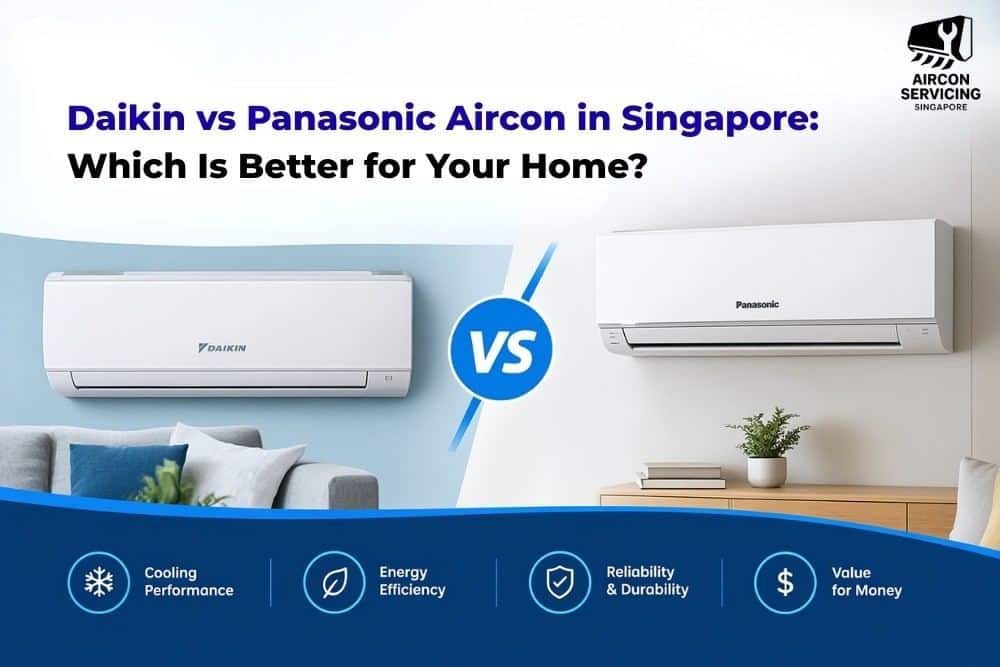
Daikin and Panasonic are two of the most common aircon brands in Singapore homes, and both are good. The better one for you depends on your budget, how many rooms you are cooling and what you care about most (price, smart features or air purification). We do aircon servicing across Singapore on both brands every week, and the honest answer is that proper aircon servicing matters more to how long your unit lasts than the logo on the front. This guide compares them so you can choose with confidence.
Neither wins outright. Both sell inverter models with up to 5 NEA ticks, both suit HDB flats and condos, and both need the same regular servicing. Panasonic is often the easier pick if you want a strong compressor warranty and air-purifying features such as nanoe. Daikin is a popular pick if you want a wide multi-split range and a long track record in Singapore. Compare the same BTU, the same tick rating and the current warranty card before you decide.
Daikin vs Panasonic at a glance
| Daikin | Panasonic | |
| Energy efficiency | Inverter models with NEA ticks; check the tick rating per model | Inverter models with NEA ticks; XU series is sold as a 5-tick premium range |
| Compressor warranty | Usually longer than the parts warranty; terms vary by model, so check the warranty card | 5-year compressor warranty shown on Panasonic Singapore’s aircon pages |
| Multi-room systems | System 2 to System 5 widely available | System 2 to System 4 and above available (for example the XU series multi-split systems) |
| Smart control | Wi-Fi control on selected models | Comfort Cloud app on Wi-Fi models |
| Air purification | Filtration and air-purifying tech on selected models | nanoe air-purifying technology on selected models |
| Typical price position | Usually mid to premium | Usually mid to premium; promos are common |
| Best for | Homeowners who want a familiar, widely installed brand with many configurations | Homeowners who value warranty promos, smart control and air-cleaning features |
Specs vary by model and generation. Always read the product page and warranty card for the exact unit you are buying.
1. Energy efficiency: look at the ticks, not the brand
In Singapore, every aircon sold must carry an NEA energy label. The label uses a rating of up to 5 ticks, and more ticks means higher energy efficiency. The label also shows an estimated annual energy cost, which is the number to compare when you are weighing two models.
That means you should not assume one brand is always cheaper to run. Compare a Daikin and a Panasonic with the same BTU and the same tick rating, then look at the annual energy cost on the label. A 5-tick model usually costs more upfront and saves more over time if you run your aircon many hours a day.
2. Warranty: the biggest practical difference
Panasonic Singapore lists a 5-year compressor warranty on its aircon systems and regularly runs extended general warranty promotions. If you buy through its official store, extra warranty years can stack on top of a promotion. These offers change, so confirm what applies on the day you buy.
Daikin’s standard warranty generally covers the compressor for longer than parts and labour, but the exact terms change by model and generation. Read the current warranty card at the point of purchase. For both brands, warranty is often conditional on installation by an authorised installer, so ask who is installing before you pay.
Why this matters: a compressor replacement is usually the most expensive aircon repair, so a long compressor warranty is worth more than most extra features. If something does go wrong outside warranty, see our aircon repair page for what to expect.
3. Price: closer than most people think
At a similar capacity and tick rating, Daikin and Panasonic tend to sit in the same price bracket, and the final price depends more on promotions, the number of indoor units and the installation scope than on brand. The most useful way to compare is to ask each seller for a total quote that includes installation, piping, casing, a bracket if needed and warranty.
If you are buying a new unit, also check whether any government scheme, such as Climate Vouchers, can offset part of the cost. Panasonic’s store states a per-transaction cap on vouchers, so confirm the rules for the brand and retailer you choose.
4. Smart features and air quality
Both brands offer Wi-Fi control on selected models. Panasonic’s Comfort Cloud app lets you control your aircon from your phone. Panasonic also promotes nanoe air-purifying technology on selected models, while Daikin offers its own air-filtration features on selected ranges.
Be realistic about these extras. Purification features do not replace cleaning. A dirty coil or blocked drain pipe will still cause bad smells and weak cooling, which is why regular servicing matters on any brand.
5. Noise and comfort
Both brands make quiet inverter models, and an inverter compressor changes speed instead of switching fully on and off, which keeps the room temperature steadier. Noise varies a lot between a basic and a premium model within the same brand, so compare the indoor unit decibel figure (dB) on the spec sheet for the exact model, especially for a bedroom.
6. Which is better for an HDB flat or condo?
For a new BTO or a condo with two to five rooms, a multi-split inverter system (System 2 to System 5) is the practical choice with either brand. Your decision should rest on three things:
- Room size and BTU. An undersized unit runs flat out and an oversized unit cools unevenly. See our aircon installation page for sizing guidance.
- Aircon ledge space. HDB ledge dimensions vary by block and era, so confirm the outdoor unit will physically fit.
- Warranty and installer. Confirm who handles claims in Singapore.
7. Servicing and maintenance: the same for both brands
Neither brand is exempt from dirt and humidity. In Singapore’s climate, we recommend a general service about every 3 months for a unit that runs daily, and a chemical wash roughly once a year or when you notice smells, weak airflow or water dripping. Our aircon servicing price page shows what a visit costs.
If you are still choosing between more than two brands, our Daikin vs Mitsubishi vs Panasonic comparison adds Mitsubishi to the mix.
So, which should you choose?
Choose Panasonic if the warranty package, a smart app and air-purifying features matter most, and you can take advantage of an active promotion.
Choose Daikin if you want a widely installed brand with many multi-split configurations and your installer or retailer offers a strong package.
Either brand is a good choice if you pick a 4 or 5-tick inverter model, size it correctly, use an authorised installer and keep it serviced.
Own a Daikin or Panasonic already? We service both brands. Book from $50
Frequently asked questions
Is Daikin or Panasonic better for Singapore homes?
Neither is better in every case. Both sell NEA-rated inverter aircons that suit HDB and condo living. Panasonic is often attractive for its 5-year compressor warranty and air-purifying features, while Daikin is popular for its wide multi-split range. Compare the same BTU, tick rating and warranty card.
Which is more energy efficient, Daikin or Panasonic?
It depends on the model, not the brand. Check the NEA energy label, which shows up to 5 ticks and an estimated annual energy cost. Compare a Daikin and a Panasonic with the same BTU and tick rating to see the real running cost difference.
Which is cheaper, Daikin or Panasonic?
They are usually in a similar price range at the same capacity and tick rating. The final price depends on promotions, the number of indoor units and installation scope. Ask for a total quote including installation and warranty from each seller.
Which brand has the better warranty?
Panasonic Singapore lists a 5-year compressor warranty and often runs extended warranty promotions. Daikin’s warranty terms vary by model, so read the current warranty card. For both, warranty may depend on installation by an authorised installer.
Is Panasonic or Daikin easier to service?
Both are serviced in a similar way by any experienced aircon technician. A general service every 3 months and a chemical wash about once a year suit both brands in Singapore’s humid climate. See our aircon servicing page.
Which is quieter, Daikin or Panasonic?
Both make quiet inverter models. Noise varies by model, so compare the indoor unit dB figure on each spec sheet, especially for bedrooms.
Which brand lasts longer?
Build quality is good on both. In practice, lifespan depends more on correct installation and regular servicing than on the brand. A neglected unit of either brand will wear out sooner.
Do I need an authorised installer to keep my warranty?
Often yes. Both brands generally tie warranty to proper installation, so confirm who installs the unit and what the installation warranty covers before you buy.
Is a System 3 enough for a 4-room HDB flat?
It can be, if the BTU of each indoor unit suits the room it serves and the outdoor unit fits your ledge. A site check before you buy is the safest way to confirm.
Can you service my Daikin or Panasonic aircon?
Yes. We service both brands across Singapore. Prices start from $50, and you can book on our contact page.